
The Reality Revolution
The New Wave of Technology Transforming Society


Between roughly 1500 and 1914, two revolutions changed the world. The first was the Scientific Revolution, led by figures such as Copernicus, Galileo, and Isaac Newton. It pioneered new methods of inquiry that helped lay the foundation for modern science, technological innovation, and the broader spread of education and literacy.
Beginning in the mid-18th century, the Industrial Revolution followed. It began largely with new developments in textiles and then expanded into steam power, iron, transportation, chemicals, and mechanized production. Over time, it transformed the global economy in previously unimaginable ways.
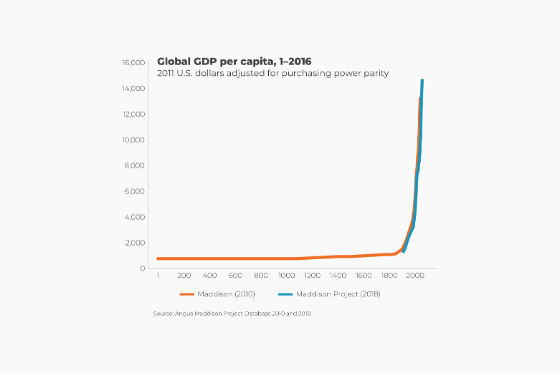
By Maddison Project estimates, global average GDP per capita roughly doubled between 1820 and 1900, more economic progress than in the prior 1,800 years combined. Over the longer run GDP per capita increased by about a factor of ten between 1820 and 2010. The percentage of the world’s population living in extreme poverty was more than 80% in 1800. In 2025 it was 10%.
This era saw the spread of the steam engine, modern textile machinery, railroads, steelmaking breakthroughs, the telegraph and telephone, mechanized agriculture, and eventually the automobile and modern oil extraction. Food, clothing, housing materials, and consumer goods became cheaper and more abundant for many people. Medical science accelerated as well: Edward Jenner’s smallpox vaccine dates to 1796; germ theory was established in the 19th century; and penicillin was discovered in 1928, igniting the development of modern antibiotics.
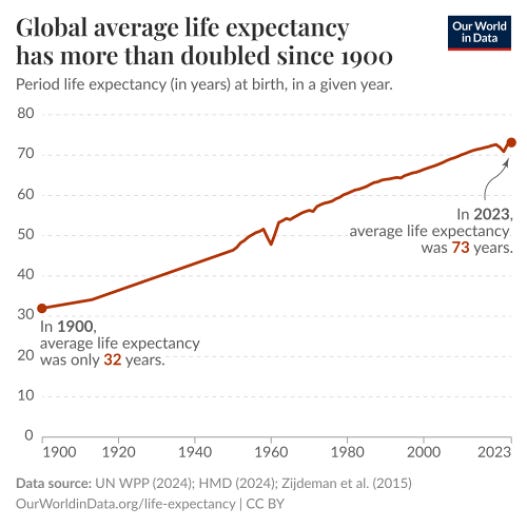
Human life changed dramatically. Global life expectancy rose from about 32 years in 1900 to 71 years in 2021. Urbanization pulled millions of people from rural areas into towns and cities. Democratic forms of government spread widely. As recently as the 19th century, famines killed significant proportions of the global population annually, but are now more rare and isolated as agricultural and technological innovations have led to historically unprecedented abundance.
The twentieth century accelerated this progress further. Humans went to space. Nuclear science made it possible to power the world cheaply cleanly, but also gave humanity—for the first time—the ability to destroy itself. Computers revolutionized almost every aspect of human life. Air travel made it possible to traverse the entire world in the time it took our ancestors to travel from one town to another. The “digital” revolution beginning in 1950 extended and accelerated the progress of the preceding centuries in ways that reshaped every element of day-to-day life.
There was great friction along the way. Workers displaced by new technologies often suffered in the short run, and this caused great political upheaval. New technologies enabled two of the most violent global conflicts in history. As the world adapted and exploited more natural resources, pollution increased and vital parts of our natural ecosystem were threatened.
But on whole, human life now versus even 100 (much less 1,000) years ago is unrecognizable: Safer, healthier, more prosperous, and freer than it’s ever been. Many problems and many social ills remain. But no sensible person would choose life in 1726 over life in 2026.
We now sit on the cusp of a new revolutionary epoch that may be even more transformative than those prior. I’ve begun to think of this as the “Reality Revolution,” because this era—more than those of the past—may not just improve human life, but reshape what it means to be human and how we perceive the world around us. The tools that power it are blurring the lines between fiction and science fiction.
I believe there are three core technologies that will shape this revolution:
1. Artificial intelligence
2. Robotics
3. Biotechnology
Driving these innovations are the two underlying capabilities that make them possible: energy and advanced manufacturing. And if successful, they might not just improve human life, but reshape it and disrupt the very way in which we perceive our world.
Artificial Intelligence
As far as we know, humans have always been the only truly intelligent life in creation—possessing an entirely different category of intelligence than other living things. We process information more quickly. We use tools more extensively. Sophisticated language allows us not just to collaborate more effectively but to record our thoughts from generation to generation in a way that has enabled the steady march of human progress. And perhaps most importantly, we possess the still mystifying capacity for consciousness. We have a conception of self. We are reflective. We dream and aspire. We create. We connect with not just the tangible but the transcendent.
AI, of course, is changing that. There is still no “Artificial General Intelligence” that possesses all the characteristics that define human intelligence. The human brain, impossibly, is still the most advanced technology in the world.
But by some measures, large language models are now smarter than any human—at least in their ability to retrieve, interpret, and synthesize information. They are faster. They run mathematical calculations humans could never process. AI in visual media and in sound is advancing so quickly as to make AI creations almost indistinguishable from the real thing. Scammers can now clone a phone number and call someone using the voice of a friend or family members. Moviemakers—or even children on phones using advanced AI applications—will soon be able to create scenes that look and sound like reality. AI programs can already write original songs and do original art. More is coming.
In healthcare, AI applications are or soon will be, exceptional diagnosticians and AI powered autonomous robots may one day make better surgeons and be able to synthesize bespoke compounds that hold the promise of curing previously devastating and intractable disease and genetic conditions.
This may unlock incredible productivity that makes the material progress of the industrial revolution look quaint. There are, of course, apocalyptic predictions around AI, as there are optimistic ones. But it is also changing our fundamental reality in ways prior technologies did not—raising both practical and philosophic questions. What are the near-term impacts of AI superintelligence on work and jobs? How will our self-conception change if we are no longer the most advanced intelligence in the universe? What if AI begins to display signs of consciousness? What happens to us as we lose our ability to distinguish between what’s real and not real?
Robotics
If artificial intelligence is the software side of this revolution, robotics is the major pathway by which it enters the physical world. Industrial machinery powered the Industrial Revolution, but a new generation of robots aims to combine mobility, dexterity, and machine intelligence in far more flexible forms.
Several companies are now developing humanoid robots, while others are advancing specialized systems such as autonomous vehicles, drones, warehouse machines, surgical platforms, and agricultural sensors. Much of this deployment remains early and task-specific, but the direction of travel is clear: more physical work will be automated, and more machine intelligence will move from screens into the built environment.
That shift has social and economic implications. The first wave of generative AI has raised concerns mainly for knowledge workers and white-collar professions—writers, bankers, lawyers, and programmers among others. More capable robots could widen that disruption into logistics, construction, field service, elder care, and other forms of embodied labor. And the scope of this potential disruption is almost limitless.
In frontier settings—disaster zones, deep-sea operations, or off-world construction—robotics may be not merely efficient but necessary. If we are to settle Mars or the moon, it will likely be robots that build the initial infrastructure or terraform the habitat to make it accommodating for fragile human biology.
This could lead to enormous progress. Safer work environments. Massive increases in productivity. Convenience the average person today can scarcely imagine—autonomous chauffeurs and household help, untiring support in our older years.
But people need meaningful work to flourish. In past technological revolutions, our outlets for that work have simply shifted. Six in 10 U.S. jobs didn’t even exist in 1940. That took time, but we adopted new technologies that expanded human productivity and shifted our areas of focus (from agriculture to manufacturing, for example, then manufacturing to technology and services). Will that past trend hold when the technology is not a compliment to humans but a substitute? Will these advances lead to greater equality or inequality? And in the most optimistic scenarios of abundance, will these technologies impede or advance our ability to work with purpose?
Biotechnology
Biotechnology may prove the most hopeful and the most morally fraught dimension of this era. Its upside is profound: gene therapies, engineered cells, neurotechnology, prosthetics, and precision medicine could reduce suffering on a scale that once seemed impossible.
This is no longer science fiction. Gene editing, for example, is now very real. In 2023, the FDA approved Casgevy, the first CRISPR/Cas9-based therapy in the United States, for certain patients with sickle cell disease. Recent reports from Australia say that a tech entrepreneur used AI to develop a bespoke MRNA vaccine to combat cancer in his dog. Neuralink implants are now allowing paralyzed patients to control things with their thoughts, and are trying to offer sight to the blind.
These technologies could eliminate or minimize previously devastating diseases and genetic conditions. Gene therapies, cybernetic enhancements, and tailored pharmaceuticals could cure neurological diseases, paralysis, blindness, or cancer. They could slow aging and extend lifespans in ways that replicate or exceed the gains in lifespans from vaccines and antibiotics of the last century. Treatment could become cheaper, more widely available, and more tailored to an individual’s biology.
They could also take darker shape. The technologies could soon exist to create genetically altered people faster, smarter, stronger than any who have existed (something Stephen Hawking once predicted). They could fundamentally change human biology. They may one day be able do so without conventional human parents (and via artificial wombs). Such developments could make current generations of people less physically or intellectually advanced than new generations. They could enhance the stigma around those with disabilities or compromise the beautiful natural diversity of humanity in ways that make society less varied or more socially striated.
When we can fundamentally change our own biology, the reality of humanity itself shifts. Those of us who adhere to religious faith place the fundamental dignity and worth of a human being beyond the reach of his or her biological traits. But even as the new age of biological enhancement may alleviate untold suffering, it could introduce grave threats which no one society alone can counter.
What All This Means
No one knows with confidence what artificial intelligence, robotics, and biotechnology will look like in two, ten, or twenty years. Some progress may stall because of energy limits, regulation, physics, economics, or social resistance. Some progress may surprise us on the upside. We should be humble about forecasting. Right now thought pieces on the direction and implications of the Reality Revolution are guesses, at best.
Historically, technological revolutions have often delivered large long-run gains while imposing painful short-run disruptions. The challenge for a free society is not to freeze history in place, but to govern change wisely: to accelerate technologies that reduce suffering and expand opportunity; to protect people who are dislocated; and to draw principled limits around uses we judge degrading, coercive, or inhuman.
That task is harder in this era because the frontier is moving closer to the core of human identity. When intelligence can be simulated, labor embodied in machines, and biology deliberately redesigned, the old question returns with renewed urgency: What is a human being, and what gives a human life dignity?
Change is coming. The next revolutionary era may be defined not only by what we can build, but by whether we can pair power with wisdom. The essential challenge is to balance optimism with restraint, invention with moral clarity, and progress with a disciplined sense of what must remain worth protecting.
