

In 1886, Leo Tolstoy published a remarkable story, “How Much Land Does a Man Need?” It follows a peasant named Pahom who becomes convinced that just a little more land will finally make him happy. His fortunes rise, his holdings grow, and still the satisfaction he seeks remains elusive. Eventually he encounters a group, the Bashkirs, who make him a beguiling offer: for a modest sum, Pahom may walk around as much land as he wishes from sunrise to sunset, and whatever territory he encircles will be his—as long as he returns to the starting point by nightfall.
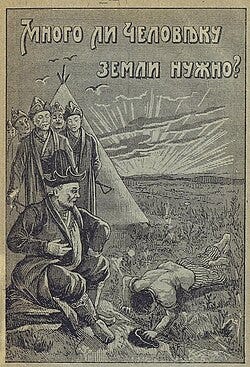
Greed blinds him. He walks farther and farther, pushing beyond prudence, finally sprinting toward the finish line as the sun sinks. He crosses the marker just in time—and drops dead on the spot.
It’s easy to sit in judgment of Pahom. He had enough, but sacrificed everything for just a little more. Yet many of us live with the same blind ambition, running a race we’re not sure we’ve ever won. We pursue more income, more security, more status, more growth—often with no clear sense of what we are pursuing or why.
Americans at all income levels say the wealth that would make them happy is something greater than what they already have. Research consistently finds that “enough” is always just beyond reach. One recent survey asked Americans how much annual income they would need to feel less stressed. At every income level, the answer was slightly higher than what they currently earned. And as incomes rose, the gap widened. Studies of high-net-worth households similarly show that many wealthy Americans do not consider themselves wealthy at all—a consequence of social comparison rather than genuine need.
In truth, most of us are like Pahom: running our financial race tirelessly with no finish line in sight.
John D. Rockefeller—by many measures the richest man of his time—was once reportedly asked how much money was enough. His answer, whether apocryphal or not, captured a timeless human impulse: “Just a little more.”
We now live in one of the most prosperous eras in human history. The average American has access to comforts and resources unimaginable only a few generations ago. But widespread prosperity introduces a new challenge. For thousands of years, most people worked simply to survive—to provide enough food, shelter, and safety to protect their families. Some Americans still struggle with these basic needs, and addressing that poverty remains a moral imperative. But for many households, survival is no longer the central goal. The new question is: How much is enough for me to stop running?
The solution, as I argue in my new book Good Money, is both radical and simple: set a financial finish line. Every individual or family can determine an income or net-worth level after which they will not continue accumulating purely for themselves. This does not mean abandoning work or ambition. Instead, it means deciding in advance what level of material well-being is sufficient—and committing that beyond that point, additional resources will be used for generosity, impact, or more meaningful pursuits.

For some, this might mean donating every dollar earned after a certain income level to charity. For others, it may mean shifting to more purposeful work once a financial cushion is achieved. For most, it means liberating themselves from the single-minded pursuit of more and focusing time and energy on what matters most: family, friendship, community, service, meaningful work, and joy.
This concept is not new. The FIRE movement (Financial Independence, Retire Early) has long encouraged individuals to reduce expenses, increase savings, and achieve financial independence earlier in life. The Finish Line Pledge, a small but growing movement, helps families set lifestyle commitments and avoid endless lifestyle creep. Financial advisors routinely help clients calculate what they need to retire comfortably, though rarely to set limits on further accumulation.
Still, setting a finish line goes beyond financial planning. It is a philosophical shift—a recognition that money is a means, not an end.
A few principles can help guide the process:
1. Calculate what you need for the life you want.
Most individuals never sit down to define their true financial needs. Doing so—with a spouse, partner, or advisor—often reveals that reasonable goals are far more attainable than assumed. Clarity brings peace and counteracts vague but powerful desires for “more.”
2. Set the finish line early.
Lifestyle creep is the death of the finish-line concept. As incomes rise, expectations rise even faster. The bigger house, nicer car, and upgraded vacations quickly become “needs” instead of luxuries. Establishing and committing to a lifestyle before wealth increases dramatically helps protect against endless escalation.
3. Share the commitment with others.
Accountability strengthens resolve. Sharing a finish line with a spouse, friend, or financial advisor increases the likelihood of sticking with it—especially when ambition or comparison threatens to reset the goalposts.
4. Decide what happens after the finish line.
Reaching a financial finish line is not the end of work—it is the beginning of freedom. Some will continue working, giving away additional income. Others will switch careers, pursue deferred passions, or dedicate time to family or service. The point is not to stop living—but to start living more fully.
Pahom could have walked an hour less and lived in comfort. Many of us, with more thoughtful constraints, could spend fewer hours chasing income and more hours investing in the relationships and activities that give life meaning.
A race is only meaningful if it has a finish line. Otherwise, it is just a treadmill. Setting that finish line—even imperfectly—can unlock extraordinary possibilities for purpose, contribution, and joy.
John Coleman is Co-CEO of Sovereign’s Capital and the author of Good Money: Six Steps to Building a Financial Life with Purpose (Harvard Business Review Press, 2026). His prior books with Harvard Business Review Press include Passion & Purpose and the HBR Guide to Crafting Your Purpose.

If you enjoy my writing, please consider purchasing my new book, Good Money. If you’ve already bought a copy, stop by Amazon, Barnes & Noble, or goodreads and post a review.
John, you and I met at a lunch in Columbus hosted by Stephen and Thompson, and share a number of mutual friends. I love this concept. My wife and I have actually been talking about this financial finish line idea a lot lately and I hadn’t seen anyone crystallize it in this way. Thanks for writing!